Lights, camera, action

P1040631It’s not formally anything to do with the long process of getting a novel from manuscript to bookshop, which is the story I have been telling in a few recent posts, but nowadays authors are encouraged by their publishers to play an increasingly large role in promoting their wares. This includes ‘having a social media presence’ – naturally not to the extent of Katy Perry or H. Styles, ahem, but still, popping up on FaceBook and the like, or writing a blog with news of lit festival appearances and talks and suitable snippets about personal life or research trips. It’s actually quite interesting to do, mostly because of the challenge of being informative and informal without droning on endlessly about oneself and one’s lovely life to the extent of alienating existing and potential readers rather than achieving the opposite.
P1040647I prefer actually meeting people in real Time and real Life though, and book groups are great for this. Last week I went to speak at my friend Neffy’s group down in deepest Herefordshire. I talked about The Kashmir Shawl to a dozen of her bookish neighbours, ate a huge dinner and drank wine, and stayed on afterwards to visit other local friends – all in the name of ‘work’.

This week’s ‘work’ activity has also centred on promotion, and so has nothing to do with the actual current business in hand, which is battling with the new novel. I feel guilty about taking so much time out from writing, but guilt is the default setting for writers anyway so I’m just going with it.

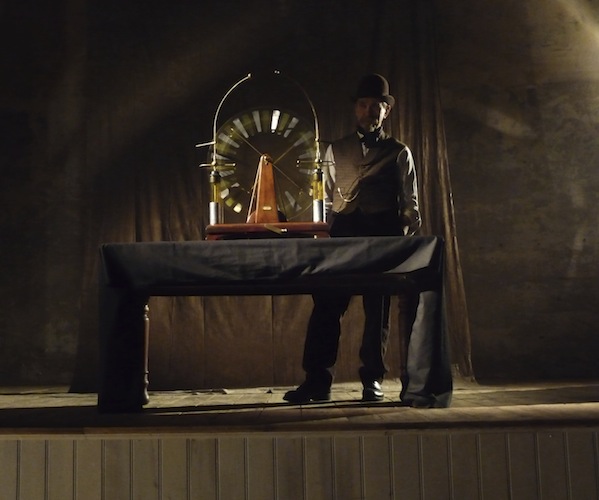
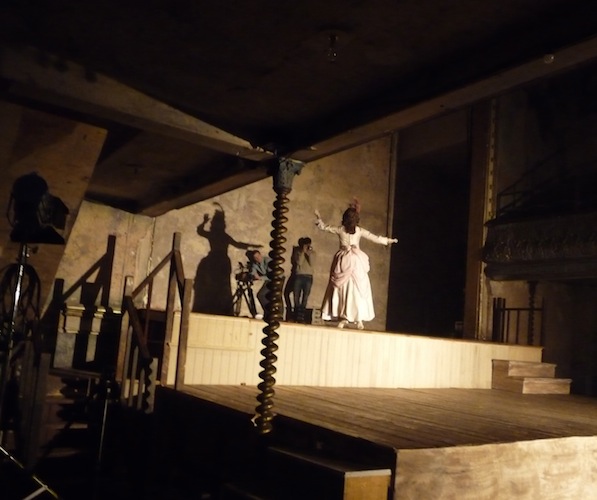
Yesterday we were at Wilton’s again, for THE ILLUSIONISTS shoot. (The book’s out in March. Did I mention this??) The project is only a 90-second promo video, but still it requires a unit of creative director, film director, cameraman, technical director from the theatre, an assistant and a runner, a stills photographer, an actor and an actress – and me (make-up and costume, dogsbody, coffee girl). Lighting the hall took forever, but nothing was left to chance. We thickened the air with vapour from a smoke machine to make Victorian murk, gingerly turned the handles of the antique Wimshurst machine (crucial to the plot) and walked the actors through their moves over and over again. Then suddenly it was action. Amazingly the director REALLY does say ‘Camera, action’ and ‘Cut’, and ‘Quiet set, please’ and all the other things you somehow only imagine in relation to Heaven’s Gate.

It was hours of hard work for all the crew and the actors, and fascinating for me to observe. Best of all was being part of a team, and seeing very young and talented people giving their work 200% of their attention. From what I could glimpse on the director’s monitor the finished video’s going to look wonderful. Today everyone’s in the studio where we’re doing the close-ups of faces and hands and making shadows move – the process of precisely replicating yesterday’s lighting from the theatre is technically arduous. Coffee runs for me.
P1040656Does all this sell books? I haven’t a clue. But it’s better to do than to ignore. I bet Dickens would have written a blog and been on Twitter ten times a day had he been able.

The author’s job is an increasingly varied one…
Not so much like hard work

At Wilton's

At Wilton’s

Back to work, which is more fun than it sounds this week. I’m making a little video to accompany THE ILLUSIONISTS, which means I can pretend to be a film hotshot for a day or so….

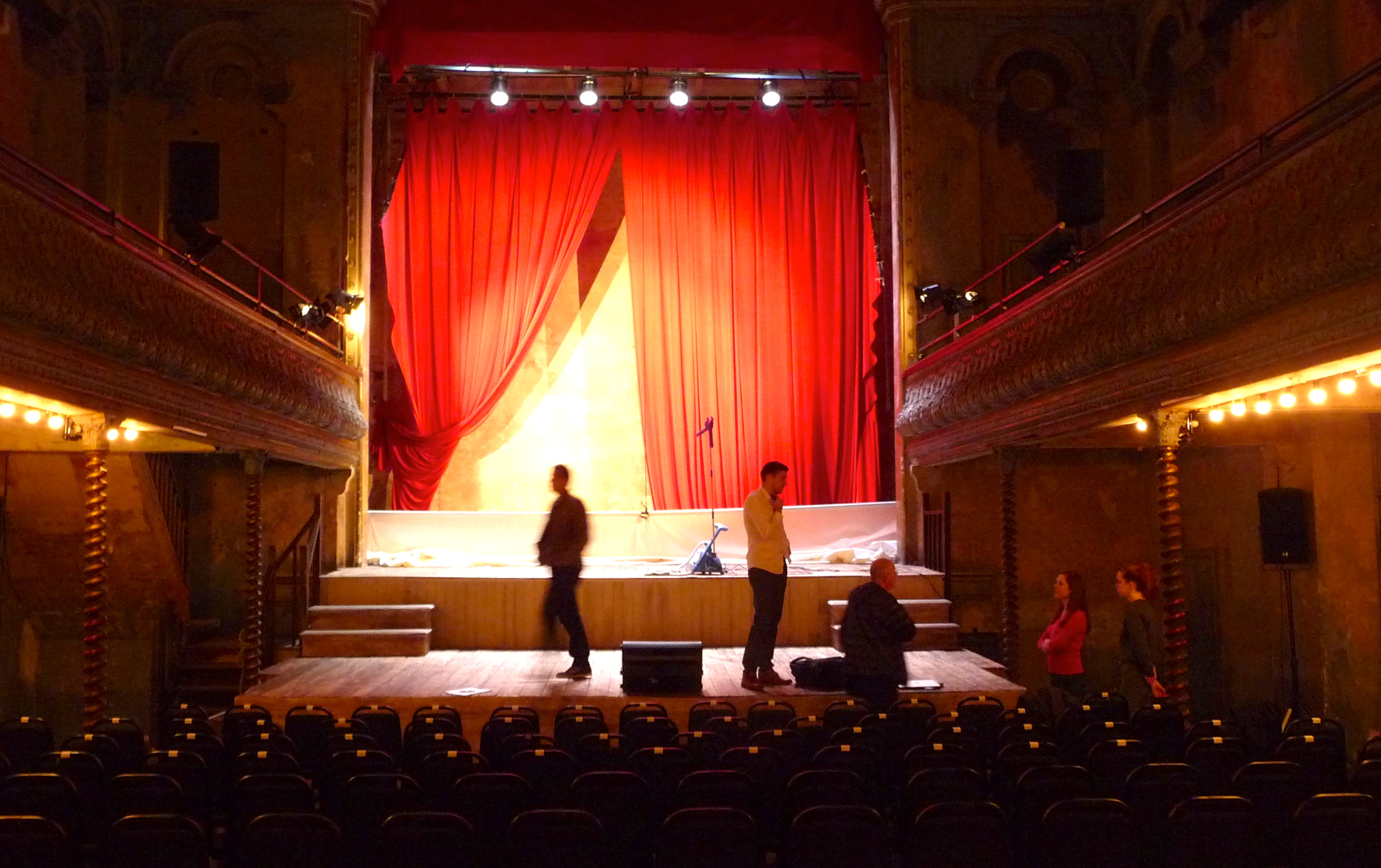
The book has a theatre setting, so we’re in Wilton’s Music Hall in the east end of London. It’s a fabulous building, and it was the backdrop I had in mind when I envisaged my own Palmyra theatre –  it’s a big excitement to use Wilton’s itself for the location. This is the pre-production meeting: actual filming will be done later this month. My usual job involves long hours of solitude, so I’m loving the collaborative aspects of working with a creative director, a film maker, and a real actor and actress. It’s also quite challenging trying to distil the atmosphere and elements of a long, juicy novel into a 90-second video. I hope it works.

The other task of the week is to read the final page proofs. This is the last of the long, intermediate stages between delivering the first manuscript and publication day. The next time I see the text it will be as a printed book.

Once the proofs are done, I’ll settle down again to the new novel. I thought I wasn’t thinking about it while I was away, but in fact I must have been because all kinds of new elements have bubbled up. All to the good. Central Asia was a HUGE adventure (pictures in the Gallery soon) but I’m so happy to be home with family and friends. One of the bonuses of travel!

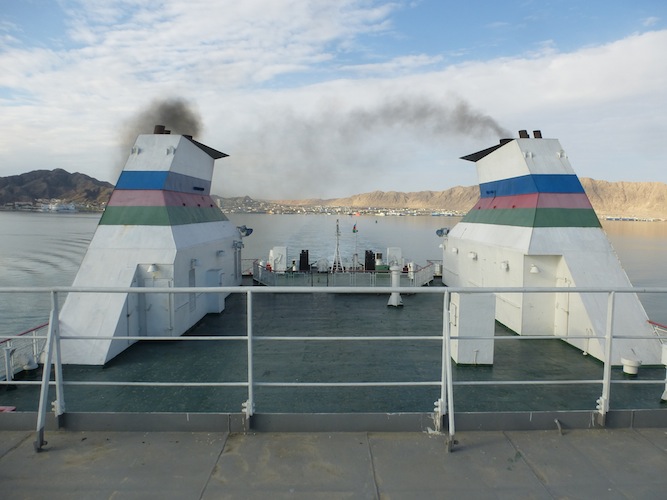
Ferry ‘cross the Caspian

Goodbye to Central Asia

Goodbye to Central Asia

These posts got backed up in Turkmenistan, because there was no internet. Apologies if the catch-up seems like a deluge.

I’d been warned, but I still believed that the ferry crossing from Turkmenbashi to Baku would be a suitable conclusion to the Central Asian adventure. In fact, the trip had almost been planned with this adventure as its climax. Slipping away from the Asian shore, leaving the Great Game arena via the gateway so many players had used to approach it – what could be more dramatic and romantic?

Ah well.

The Transcaspian Railway ferry Akademik Hesen Aliev looked unprepossessing enough at the Turkmen dockside. A tired, stumpy old ship closer to a Channel ferry in need of a re-spray than a stately Silk Road galleon…

We were hustled through customs and passport sheds at a great rate because the boat was on a fast turnaround and the captain didn’t want his passengers (there were just the two of us) holding up the departure.

On the quay we met a dazed British boy disembarking with his motorbike. ‘Five days from Baku on that thing’ he muttered. ‘It’s supposed to take seventeen hours’.

We commiserated and blithely passed on, into the guts of the ship past the rail freight wagons hunkered in the hold and up skeins of steel ladders to the cabin deck. Please don’t imagine white-jacketed stewards and strains of Glenn Miller. Much more Russian crewman in soiled vest, stink of crude oil, peeling grey lino. And the cabin itself, in the spectral light filtering through brown nylon curtain? Two torn mattresses, one neon striplight, a cubicle with a broken lavatory and a basin hanging off the wall. The whole  luxurious suite was papered in some oily material that visibly shivered with subcutaneous cockroach activity. We laughed, slightly nervously. As for the fast turnaround – the minute we were trapped on board and our passports  removed everything came to  standstill.

It was four hours before the Akademik ploughed away from the dock, and as soon as it did so it became clear that our romantic boat was a fifty-year-old fourth-hand rust bucket, a shuddering firetrap of a barely-crewed ghost ship without a lifejacket on board and no hope of escaping the catastrophic fire that would surely break out at any minute. The lifeboats were fused into the davits and clearly hadn’t been tested since the Volga Boatman last sang in the cabaret.

Actually it was flat calm and the night passed, sleepless for me because I was on bug watch, but uneventful. We’d embarked at midday, and by 10 am we were approaching Baku – hungry, because we’d hurried aboard without time to stock up with provisions as advised, and dirty because that was preferable to dealing with the ‘bathroom’, but – hey – there we were, and Azerbaijan obviously had coffee and food, because I could SMELL them from 500 yards off in the bay.

Unfortunately 500 yards was as close as we were to come. The engines stopped and the anchor cable rattled over the winch. We would have  to wait for dock access. No one knew when it would be granted.

The hot empty hours crawled by. Lunchtime (no lunch) and dinnertime (likewise) came and went. Darkness fell. No one knew anything. Five days began to seem a distinct possibility. Across the oily water Baku glittered like an exotic vision, never to become reality. At midnight I put on my pyjamas and crawled into my makeshift cockroach exclusion cocoon once more.

As soon as I had dropped off, the engines started up.

There’s a happy ending. By 3 a.m. I was draining the hotel mini bar and gobbling Snickers in the shower. I’ve never been so happy.

You might want to book a honeymoon trip aboard the Turkmenbashi-Baku Caspian ferry. Or you might not. Baku itself is a glamorous, oil-rich city full of designer shops and cafe bars, with an ancient silk road settlement of carvanserais and hammans at its heart. Which seems to encapsulate rather neatly the opposite poles of this adventure.

It has been amazing, in the real sense of the word. Tomorrow – LONDON!!!!!!

Wild camping

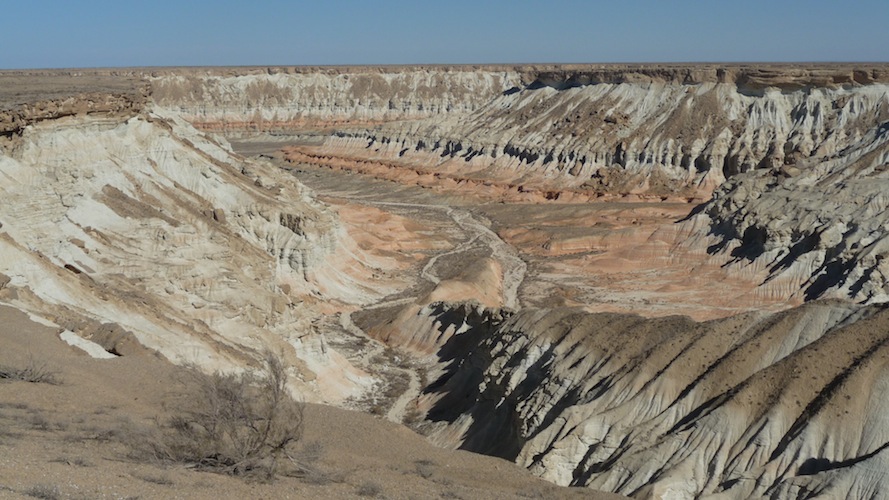
Yangikala Canyon

Yangikala Canyon

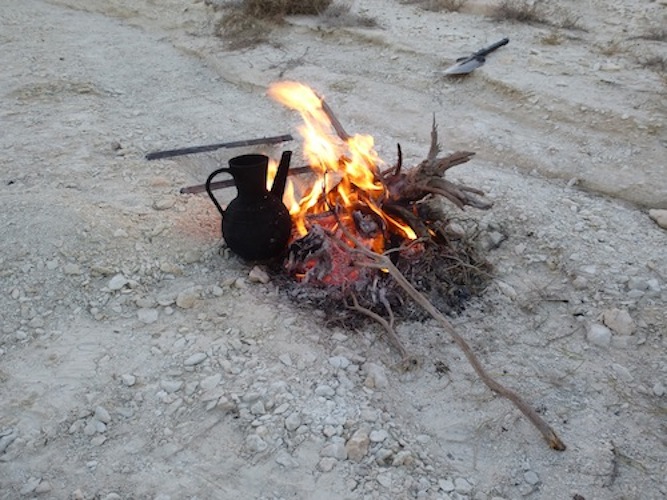
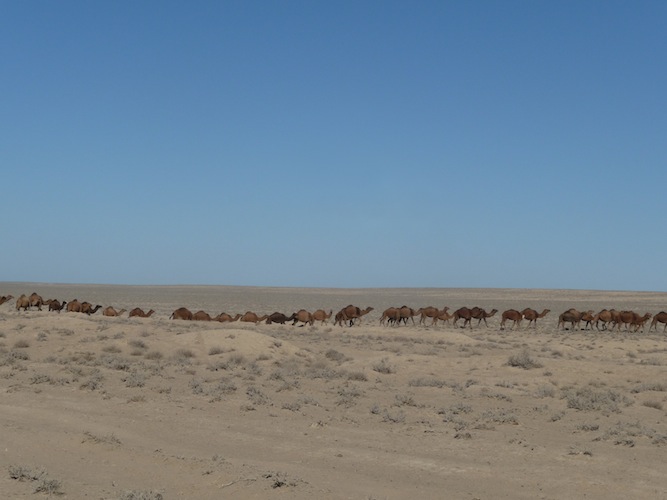
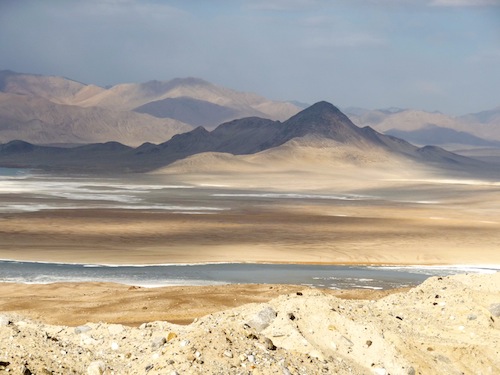
The Yangikala canyons run down to the Caspian in the west of Turkmenistan. They are deep fissures of multicoloured rock layers with buttresses of fluted chalk. The colours are other-worldly, from tangerine through pale gold to pistachio, particularly at dawn and at sunset. We reached this strange place after a four-hour drive from the coastal port of Turkmenbashi, through yet more trackless desert, where shepherds mind their herds of camels and nomads pass from summer encampments to take shelter for the winter in mud huddles of villages. We spent three days walking, taking photographs (yes! photography allowed!) that unfortunately don’t remotely capture the scenery, and poking about for fossils. Our companions built fires and raked embers to boil the little black teapot and barbecue the shashlik. They smoked intently, and drank a lot of vodka. ‘Vodochka’, they crooned affectionately. Life’s hard in the desert.

Boiling the kettle

Boiling the kettle

Wild camping was as camping always is: delight spiked with plenty of discomfort. The days were sunny and cool, nights windy and bitterly cold. The US military sleeping bags lent to us for the excursion were good and warm, though.

Camels in the desert

Camels in the desert

The North Korea of Central Asia

Soviet bridge across the Oxus

Soviet bridge across the Oxus

Our new guide is called Rustum. An accompanying guide is mandatory for all tourists in Turkmenistan – can’t have people wandering about photographing the statues of the President at will, after all. In fact photography is also banned in places that seem superficially uncontroversial, like the vegetable market or the spiffing new railway station in Ashgabat. Rustum is young and fashionable, and fun to be with. He’s wearing combat trousers with complicated ruching, the latest Salomon trekking boots, a draped leather jacket, a baseball cap and Raybans. He’s very interested in watches and cars – his second question is what make of car do I drive? Luckily the answer seems satisfactory. Rustum hasn’t heard the story that is the basis of Arnold’s poem – fair enough, my acquaintance with Turkman epics is nil – but for me the association gives him a sort of literary-heroic glamour. We enjoy our time in his company.

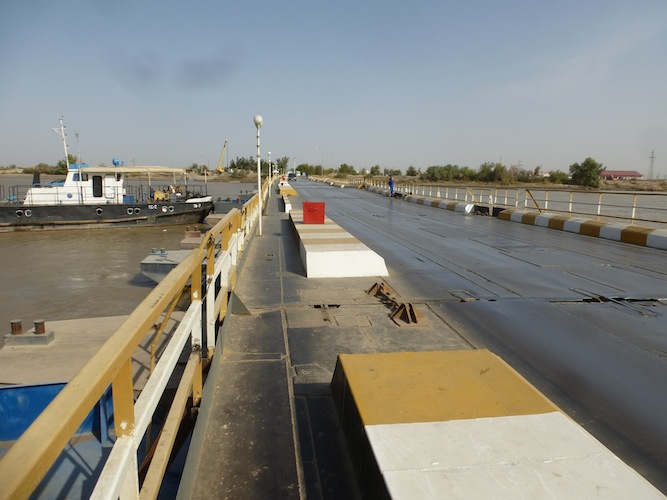
On the way from the border we crossed the Oxus at last, via a pontoon bridge constructed by the Soviets. No photography. Downriver is a much older bridge carrying the railway line from the Caspian to Tashkent. Lord Curzon passed across it on his way to Kashgar, long before he became Viceroy of India. It was sad finally to leave the river and its history and turn our faces westwards.

The first visit was to the ancient city of Merv, once known as the Queen of the World, and a thriving place even in the late nineteenth century. Now it’s just ruins, and the reconstructed – very beautiful – mausoleum of Sultan Sanjar. The next day Rustum and a pair of mad Russian friends of his in a 4WD took us on a three-hour drive into the desert to visit Margush, another ruined city, dating back to the Bronze Age. Acres and acres of unexcavated remains lie under the sand, and a fort and necropolis that have been dug out and studied. The burial sites feature animal sacrifices – the skeleton of a magnificent stallion, donkeys and camels and lambs, interred with the king and his ceremonial artefacts. This huge site is almost unvisited – I wish I could have stayed and wandered for a week.

We ate our picnic lunch under a tin canopy erected to shade the archaeologists, while the rain poured down. One of the Russians stopped smoking for long enough to murmur, ‘Just like England’. It was my birthday – one I won’t easily forget.

Ashgabat

Ashgabat

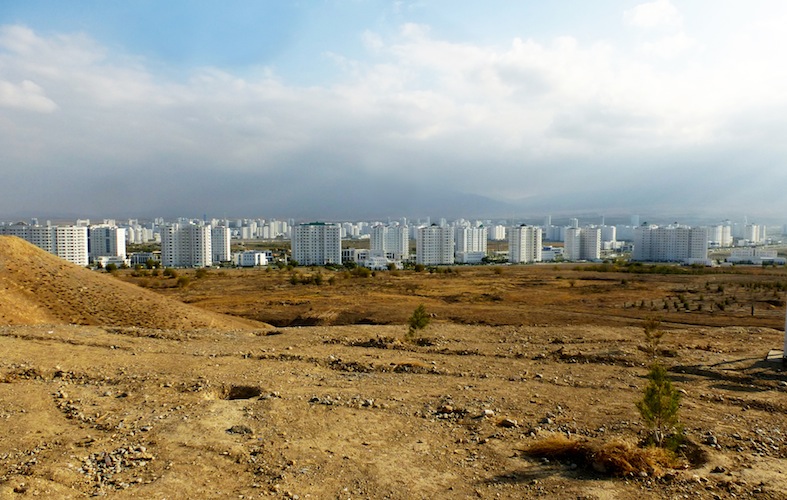
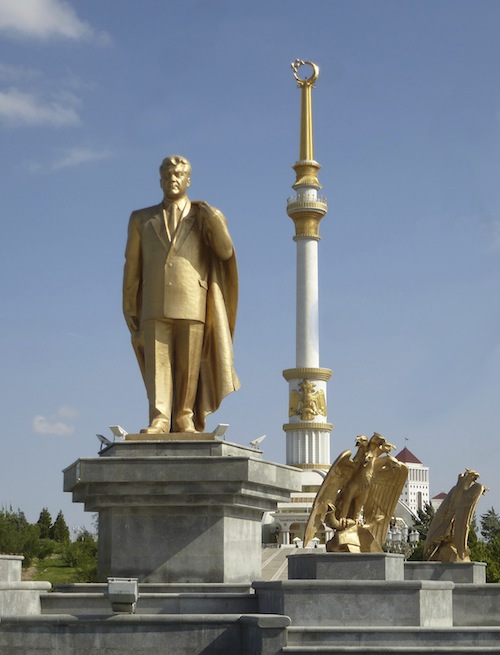
The next day we came to Ashgabat, President Gurbanguly Berdimuhamedow’s eerie white marble capital city. What with Rustum’s hipness and the archetypal Russians and the general friendliness of everyone we met, even the dismal familiarity of rundown ex-Soviet hotels, Turkmenistan had seemed quite accessible. But once we got to Ashgabat all that changed. It’s the capital: I imagined there would be internet, mobile phone signal, general availability of connection and dissemination. But no. Facebook and western social media are blocked, and the internet is so slow as to be not worth the bother. Phone and text are mysteriously askew. There are police and military and men in black with earpieces to enforce the No Photography rules, and no doubt all other infringements. Of course this is a police state, unreadable and impenetrable. Even Rustum must have signed off on it at least nominally, or he wouldn’t have a job in tourism. And then the city itself! A shiny mirage bursting out of the sand, where giant white buildings tower over deserted motorways. It bristles with absurd monuments like the vast Arch of Neutrality, a giant tripod topped off with a golden statue of the previous President, and multi-billion edifices constructed to reflect their function – the national Library in the shape of an open book, the dental hospital as a colossal molar, a grotesque new hotel as a drop of water, the most precious commodity in the desert. In all these white marble expanses there are hardly any actual people to be seen. We toured the excellent National Museum, three floors spreading over three wings, and were the only visitors.

Independence Monument and Presidential statue

Independence Monument and Presidential statue

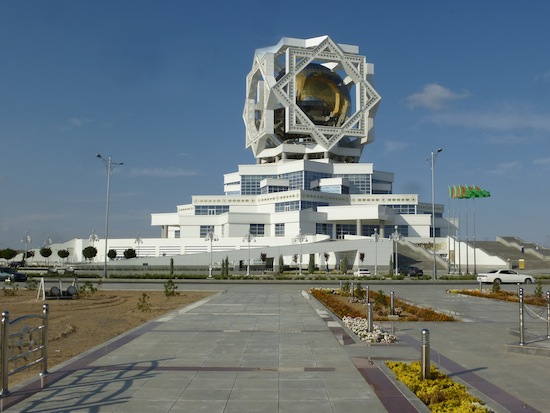
Marriage Palace

Marriage Palace

The whole of Ashgabat was like a sci-fi city in a film, or a version of paradise glimpsed in a queasy dream. I didn’t mind leaving it behind to go camping.

Out of Uzbekistan


Bokhara

A quick dash through Uzbekistan, and no particular desire to linger. The route led from the border southwards to Termez, an ancient Silk Road city facing Afghanistan again across the Oxus.

It has a faintly threatening feel to it now, due to the smuggling problem, and to other tensions I can only guess at. There was a family celebration going on at the neon-lit cafe where we ate our shashlik dinner and though it seemed jolly at first there was an uncomfortable insistence that we join the party. Bottles of beer appeared on our table and a mother and son sat down and demanded we drink toasts with them. ‘To Uzbekistan!’ We did our best, then the woman dragged me on to the dance floor, hanging off me as she swayed to the music. It’s very unusual indeed in a Muslim country to see a woman drunk in public. It was a relief to slide away into the darkness and trudge back to the comfortless ‘hotel’ for the night.

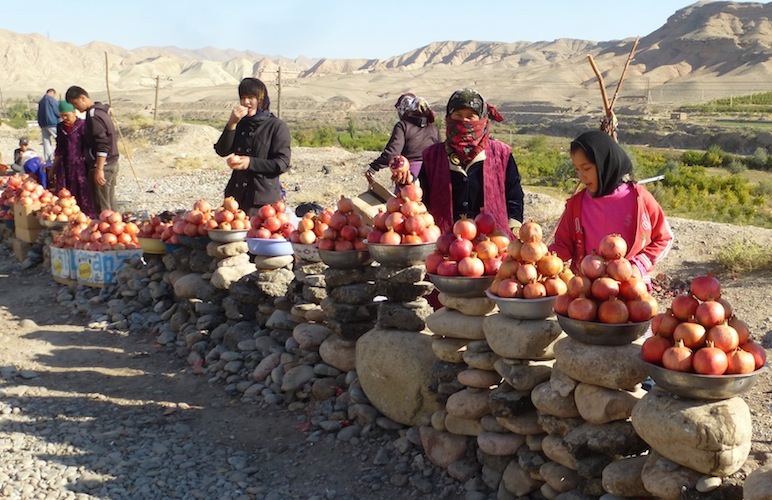
Pomegranates

Things didn’t improve much the next day, as we made a northwards turn to head up through the barren centre of the country. It’s a hot and desolate place of scrub, dust, broken-down concrete buildings and marching pylons. Most of the sparse traffic is heavy container trucks and at the police ‘registration’ points along the road these and the few private vehicles are pulled over to be searched for drugs and arms. At one of these points a policewoman tipped the contents of my bag on to the floor and stirred through them, then body-searched me, making mocking gestures to indicate my scrawnyness to her ample companions as she did so. Thinnist policing in action. Who wouldn’t have shed a a pound or two after a month on the Central Asian diet, I’d like to  know? (It’s a no choice option of mutton followed by more mutton, if anyone would like to give it a try).

We did stay in beautiful Bokhara which made up for everything, although the ancient Lyabi Hausz cistern at its heart has acquired fairy lights in the trees and coloured fountains since my last visit. And there were busloads of tourists. (I know! I’m a tourist too!! But afflicted with traveller’s snobbery because we haven’t met anyone else along our eccentric route since Gillian all the way back in Ishkashim). At least in the Bokharan fleshpots we were able to enjoy a bottle of wine-style beverage, from Moldova, with the shashlik.

Next morning we were at the border with Turkmenistan. The two frontier posts are separated by a kilometre of dusty no-man’s land, and at either side an endless queue of steaming and hissing trucks waiting to make the crossing. Apparently this can take up to a week. We were much luckier – only two hours.

And then we were in Turkmenistan.

It’s not known as the North Korea of Central Asia for nothing.

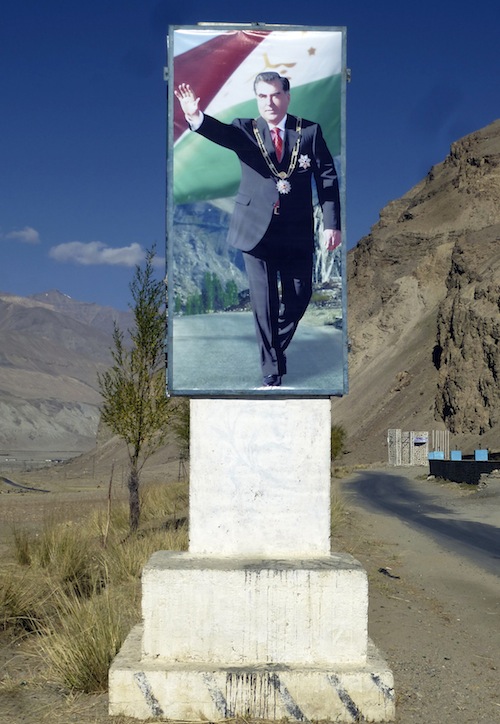
President Emomali Rahmon of Tajikistan

Emomalii Rahmon President of Tajikistan


The best bit of the whole Tajikistan visit was the drive from Langar village to Ishkashim, the point where the Wakhan valley narrows to a rocky gorge. All along the valley, through quiet villages and gentle apple orchards, the wild Hindu Kush reared across the river. Any one of these peaks would be a significant mountain in Europe, yet here there are dozens of them. I stared out of the car window for hours, entranced.

Ishkashim itself is a border village with a frontier feel. Here is one of the two bridges that allows non-Tajik or Afghan nationals to cross between the two countries, so there is a trickle of coming and going and a faint air of tension heightened by the presence of the military. There is a strict prohibition on non-residents going anywhere near the river bank unless heading for the border crossing, and photography is frowned upon. An Afghan market takes place on a no-man’s-land island in the middle of the river, for which no visa is necessary, but only on Saturdays – unfortunately we arrived on Sunday. We did have a mooch around town before leaving, and we spotted one of the big Chinese trucks from the Pamir Highway discreetly parked in a side alley. Case after case of Russian vodka was being offloaded. Someone told us that this is sold under the counter at the Saturday market – the Afghans love it, but it’s very expensive for them. They can’t pay cash for it, and no one actually mentioned what currency they do use. I could hazard a guess, though.

The President also visited Ishkashim on his recent tour. There is evidence in a brand new strip of asphalt laid through the village centre, and some new turf and dwarf conifers already fading for lack of water. One of the locals told us a good story.  The President made his way to a potato field on the village outskirts, where the television crews filmed him and the smiling peasantry together digging up the wonderful crop of big potatoes. Unfortunately the rather small potatoes from these fields had been harvested a month ago, so the asphalt- and turf-laying teams simply buried a few rows of spectacular spuds so they could be lifted to full advantage. Our guide asked if the village at least got to keep the bags of potatoes once the tv crews were done. Not at all, he was told. They were bagged up again and driven to the next village so the process could be repeated.

This is a standard-issue Central Asian kleptocracy, but it’s quite hard to believe what goes on until you actually see and hear it. The traffic police, for example. They stop motorists on a random basis and policeman and driver exchange a brotherly handshake in which a 3-somoni note changes hands. Time after time. We asked about this and were told that the policeman has to rent his radar equipment – without which he can’t do his job – for $100 a day, from his superior officer. So he needs to stop quite a lot of motorists, at a rate of 4.8 somoni to the dollar.

Tomorrow morning early we leave for the border crossing into Uzbekistan, and from there onwards to Termez and Bokhara. Probably just as well….

Encounters on the road

At Bulunkul we met a cheerful young Swiss couple, Jonas and Alexandra. Environmental engineers working on a hydrology programme, they both spoke a little Tajik and were taking a hitch-hiking holiday through the Pamirs. They squeezed into our room after we had eaten our dinner, and we sat chatting by the stove. There is no vehicle traffic to speak of along the track down to the Highway and they had accepted that they would have to walk the 16kms before any hope of a lift. So they were glad to see us in a 4WD with one and a half seats to spare and the same planned destination – Langar, a little village down in the Wakhan Corridor. When the time came for us to leave Jonas took the middle seat and Alexandra perched on the luggage in the back. The drive was sensational – winding past lakes and high peaks, across the Alichur mountains via the Khargush pass, the highest yet at 4344m. In the whole 6-hour journey we saw one other vehicle, an army patrol truck.

Our route met the Afghan border once more and at one point we stopped to watch a camel caravan passing on the other side. The men paced beside laden camels, the women and old people rode donkeys, and the line wound steadily along the dirt track over low hills. It occurred to us all that this scene can hardly have changed in a thousand years. Jonas ran down to the bank to call out to them. He learned that they were nomad families, carrying with them everything they possessed, and heading to the Afghan bazaar in Ishkashim. Oris was not pleased with this cross-river fraternisation – it’s forbidden by the Tajik authorities in case of spying/smuggling, and a German tourist was recently arrested for it. He spent 10 days in prison, was fined $2000 and expelled from the country. Jonas laughed merrily at this information.

Afghan nomads

Finally we came to Langar, the first of a chain of tiny whitewashed villages lying along the bank of the Panj river (although for me it will always go by its ancient name of the Oxus), looking across to the vast peaks of the Hindu Kush. The Wakhan Corridor is a thin spur sticking out eastwards from the northern corner of Afghanistan, created by the British in 1893 as a late move in the Great Game to form a barrier between the southernmost extent of the threatening Russian dominions and the mountain passes into British India. At the corridor’s narrowest point it is only 30 kms of mountain wilderness southwards to the Pakistan border – to India as it then was, of course. The river is now the border, with the Tajik police and army patrols on one side and on the other the Afghan men in their pakol hats and women in blue burqas. But this wide valley was once one domain and the people are ethnically identical.

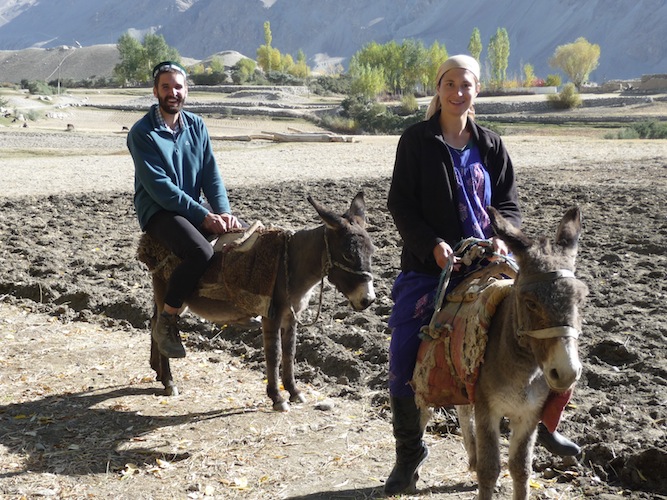
Our room in the tiny guesthouse at Langar had rugs on the walls as well as the floor. Disorientating in the middle of the night. While we were trying to sleep, Alexandra and Jonas were hatching A Plan for their onward journey to Khorog, about 200 kms further along the corridor. They would buy a donkey to carry their minimal luggage, and walk it there. By the time we emerged from our room for breakfast, sneezing and itchy from the dust, they had already sourced and purchased TWO donkeys, for 100 euros apiece. They climbed on to the beasts and urged them to move with polite European slaps and shouts. Neither donkey stirred until Nuraddin, our driver, thrashed their rears with a stick. The large crowd of Langar residents roared with laughter. In the end we had to move on and leave the Swiss to the donkey dilemma. We exchanged email addresses and Alexandra presented me with a Swiss Army penknife, which I am very pleased to have.

The Swiss and the donkeys

For the rest of the drive we chuckled from time to time and wondered how they were getting along, imagining that together with the German cellist (see previous post) they were the oddest representatives of On the Road in Tajikistan. That was until two days later, when we met Gillian from Edinburgh in the Hanis guesthouse in Ishkashim. She was the only other guest and we were exchanging stories over ‘dinner’. It turned out that Gillian had just cycled over the pass and down the Wakhan Corridor, all the remote way we had just come. What’s more, she had done it alone – and this was just the most recent leg of her journey, because she had ridden all the way from Thailand. My jaw fell into my mutton soup, but Gillian was perfectly matter-of-fact. She asked us if we could give her a lift onwards to Khorog, and of course we said we’d be glad to. But by the morning, plans had changed – as they do around here. Gillian had bought herself a ticket on one of the taxi-buses that do the 18-hour journey between Ishkashim and Dushanbe. Her bike was strapped on the roof rack and we waved her off. Perhaps we’ll catch up with her in Dushanbe, from where we’ll all be heading to Uzbekistan.

Langar carpeted room

Bulunkul

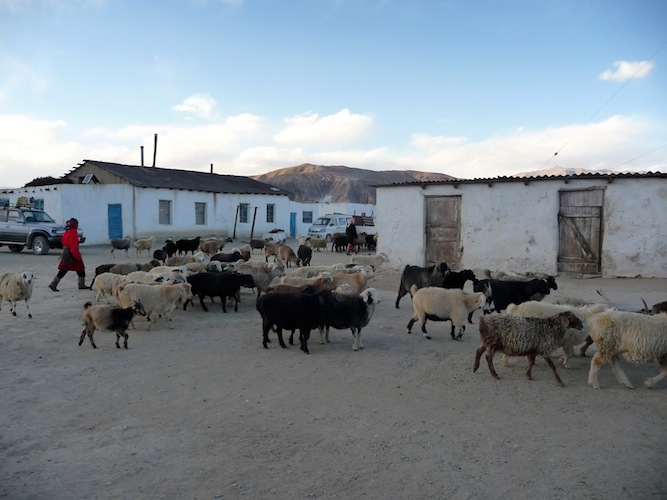
Goats coming home

We have been in Bulunkul, a tiny village in the western Pamir region of Tajikistan. Tajikistan is a poor country and the mountainous Pamir its least-developed area. Bulunkul itself is remote even by Pamiri standards – it lies a long 16 kilometres of dirt road off the Pamir Highway, and if ‘Highway’ sounds like something with four lanes and tarmac, then re-imagine. It’s a rocky track winding over 4000m passes, the dusty surface constantly pounded by the heavy trucks bringing cheap Chinese goods into the Tajik bazaars.

We arrived late in the afternoon, to find the sky veiled with smoke from the chimneys of low white houses and the children bringing in their flocks of goats for the night. The village lies at one end of a small chain of surreally turquoise lakes surrounded by bare mountains with snowy summits. The lakes were stocked with trout by the Soviets and the villagers survive by fishing and herding.There are only thirty-five families in Bulunkul – in a way it’s surprising that there are as many – and in this subsistence world everyone helps each other. Everything is communally owned and decisions are made by a committee of elders. Like a parish council with real clout, I suppose.

Yak dung fire

Some of the householders take in occasional tourist visitors (there can’t be many) for $15 per night, including food. We had a sparse little room with two padded mats laid on the floor in front of a stove made of old lorry-sides, which our cheery host stoked up with cakes of fuel made from dried yak dung. It was cold outside, but the room was soon cosy. We sat cross-legged on the floor to eat a plate of boiled buckwheat spiked with some shards of onion, and drank cups of green tea. The next night there was richer fare because a yak was butchered, and we ate a tasty stew of its offal. The village cats delicately gnawed the last shreds of meat off the hide, and the next morning all that remained of the beast was its four trotters laid out in the middle of the village.

I had one of those nights that required a series of nocturnal visits to the tin shed latrine, quite an inconvenient distance away in a temperature of minus 10, but as I shuffled through the thick, soft dust I was tempted to linger and wonder at the stars. No gentle twinkle here. They were puffs and twirls and hard points of steely brilliance and the blackness between them was so dense it seemed to bulge like buttoned black leather.

We spent our days walking. With a pair of young Swiss hydrologists (more about them in the next post) I tried and failed to climb a modest 5700m peak overlooking the far end of the lake. Even from the viewpoint I did manage to gain, the view of lakes reflecting bare mountains was worth every panting step in the thin air.

I won’t forget Bulunkul in a hurry, or the grace and hospitality of its inhabitants.

View from the little mountain

On the banks of the Oxus

The Oxus River

We were woken up at 5.15 this morning by Oris knocking on the door. The road out of town was going to be closed at 5.30 as part of the security for a visit from the President. There’s an ‘election’ next month, and he is out showing himself to the people. Unluckily for us he’s following the same route as we are, but as he travels by helicopter he tends to arrive first. So all the hotel rooms are commandeered for his entourage – 400 people, because he likes to bring all his ministers and committee bosses with him. That’s why we were in a downscale homestay last night in Khalaikumb rather than the pretty guest house we’d booked, and the reason why our plans have all gone awry. We can’t make new ones either, since the President decides his movements on a whim so no one knows where he’ll be heading next.

We had planned to treat ourselves to a couple of nights in one of the Aga Khan’s chain of lovely Serena Hotels here in Khorog. Booked it weeks ago. BUT the entourage has taken over the whole hotel and we have been sent off to a lowly spot down the hill as befits our tourist status. It doesn’t matter at all, considering what we have seen today. We have been driving along the fabled Oxus river (to reach this is quite something, as Great Game enthusiasts like me will well know).  Thirty yards away are the mud villages of Afghanistan, as in the picture.